




Not long ago, when President William Ruto and his Deputy Kithure Kindiki pledged to construct 22 modern markets across Meru and Tharaka Nithi counties at a cost of Sh4.6 billion,than Beatrice Kathambi a veteran Mama Mboga vendor from Gatunga market in Tharaka North, dismissed the promise as another political campaign lofty words that would soon be carried away by the political wind
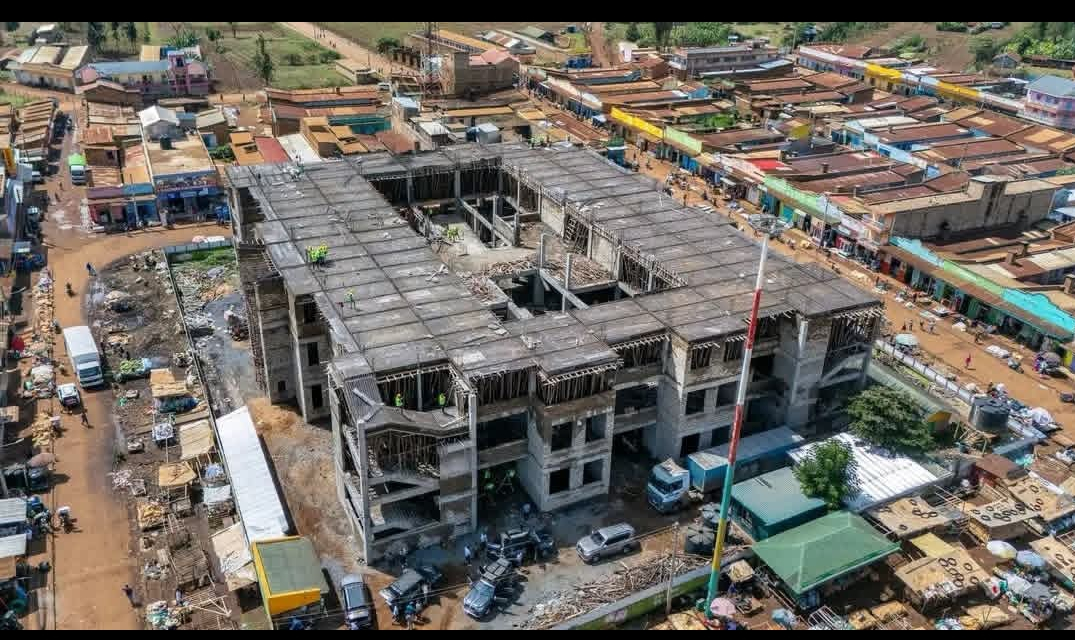
Today , with unbelievable eyes,she stands just a few meters away from the nearly complete two- storey Gatunga Modern Market structure 90 percent complete rising from the ground like a symbol of long-awaited change of hope for small – scale traders.

The facility gleams with modern technology is fully equiped with cold rooms, dry storage areas, an ICT hub, a children’s room, a food court, Kitchen ,proper sanitation, electricity and clean running water.
Kathambi’s eyes however linger on the building, her face breaking into a smile that carries both disbelief and gratitude as she sell her vegetables under the unforgiving mid-morning scorching sun.
Kathambi however adjusts her faded leso over her shoulders as she watches her baby sleep peacefully beneath the shade of a dry lone tree besides her a wooden semi structure timber frame patched together carrying the weight of semi- dry vegetables,tomatoes ,potatoes and fruits which days were counted from getting bad.

For decades she noted, when the sun blazes, it offers little protection her produce dry up and rot to waste yet, for years she has not given up beside counting losses under her fragile structure that has been her lifeline and source of hope.
“I never thought I would see this in my lifetime now I am just waiting for the day I will move in to the new facility no more hot sun ,no more losses because there is cold room for preservation of products now we are sure our income will go high,”she said .
For Kathambi and thousands like her, this is more than infrastructure but life time transformation.

Across the market, Patrick Kinoti, a fruit vendor, arranges mangoes,avocado ,oranges and bananas in neat piles he, too, has witnessed the evolution of his surroundings with ESP market .
“Since Independence, we have never seen such development here like tarmack roads, electricity, modern markets count them it feels like we are finally being remembered we are so thankful to Kenya Kwanza government,’ said Kinoti .
For Kinoti,speaking of past Tharaka Nithi with a tone that blends frustration and relief, however said the transformative changes go beyond physical structures signaling recognition of regions that has been long felt sidelined.
“We have been marginalized for years but after our son Kithure Kindiki was appointed to the DP office now, things are changing what we are seeing is like a miracle.” lamented Kinoti.
In Cheera market, Lucy Kawira is not left behind,she paints a vivid picture of the daily struggles that define the life of a small-scale trader she gestures toward a heap of overripe tomatoes, their skins splitting under the heat.

“This is our biggest loss Most of what we sell are fruits and vegetable which are highly perishable so by the end of the day, a lot goes into waste,’ she said.
“Mama Mboga cannot become rich yes we work hard, but losses eat into everything we earn sometimes you just take the spoiled produce to pigs or throw it into a compost pit but the promise of cold storage in the new markets has ignited hope that means fewer losses and better profits this will change our lives.”she noted .
In Kianjai, Tigania West, the winds are relentless they whip through the open market, carrying dust that settles on vegetables and into the eyes of traders and when the rains falls the story changes but not for the better but for worse these were the painful words of Martha Kinoti, a trader in the area who described the upcoming modern market as a live changer .
“You are drenched your goods are soaked your customers disappear and then with all the effort you finally go home with almost nothing.”she said.
The three-story modern market nearing completion in Kianjai, built at a cost of Sh305 million, promises to accommodate about a large number of traders for a region with over 5,000 small business operators.

Samuel Mutharia, chairman of Kianjai traders, highlights another overlooked challenge where young children are faced with health risk while they accompany their mothers to the market.
“Many women come to the market with their young breastfeeding children the environment here is not safe when it is too hot or too cold, the children fall sick but with the new market we have better conditions, even spaces for children something we have never thought of,” he said.
Sanitation has long been a silent crisis in traditional markets.
Lucy Mwiti from Kianjai recalls the discomfort and health risks traders endure daily.

“When it rains, the entire market floods there is no proper drainage. We stand in dirty water while selling food there are no toilets no clean water and such conditions not only endanger traders but also pose risks to consumers as well but with the new markets, we will finally have clean environments and this will help us sell food in a place that has dignity,” she added.
Beyond infrastructure, traders in Timau ,Kiirua in Buuri constituency are now thinking bigger about value addition and economic sustainability.
Many are calling on the government to establish small-scale processing units within the markets idea they said will help mitigate the loss of perishable goods like fruits .
“In stead of letting fruits rot, they could be processed into juice or other products if we had small processing factories set up in these modern markets we could sell our surplus produce instead of losing it,” said Mary Karimi.
In Kangeta market, 21 year old GenZ hawker John Kaume speaks about another challenge of security.
“At night, the market is dark there is no electricity and that makes it unsafe but with the installation of electricity and Wi-Fi in modern markets will enable us to work even at night and we can also do business online,” noted Kaume.
The numbers behind the transformation are staggering.
In Meru County alone, 18 markets are under construction at a cost of Sh3.3 billion, many nearing 80 percent completion and in Tharaka Nithi, four markets across three sub-counties are being built at a cost of Sh1.2 billion.

Among them, Gakoromone Market get the lion share of Sh1 billion project set to become the largest market in Kenya and possibly in East and Central Africa after completion.
Other markets in the region, including Timau, Kiirua, Gikumene, Gatimbi, Muujwa, Mwichiune, Igoji, Kamachege, Mulika, Kangeta and Athiru Gaiti, each being developed at costs ranging between Sh55 million and Sh70 million.
In Tharaka Nithi, key facilities include markets in Chogoria, Cheera, Gatunga and the ambitious three-tier Chuka Modern Market, valued at Sh350 million.
The Chuka Modern Market, now 58 percent complete, is already reshaping the local economy designed to accommodate 373 traders across three levels, it offers structured weatherproof spaces that contrast sharply with the informal setups traders have long endured.
Beyond trading, the construction itself has created jobs, stimulated demand for local goods and services.
It stands as a critical hub positioned to boost agricultural sector ,attract investors and enhance small enterprise operations across the country.

The developments showcases the government’s broader vision to living the the promise of growing the country to the third world status.
These developments are part of the Economic Stimulus Programme (ESP), aligned with the Bottom-Up Economic Transformation Agenda (BETA), which seeks to empower small-scale traders, strengthen food systems and drive inclusive growth.